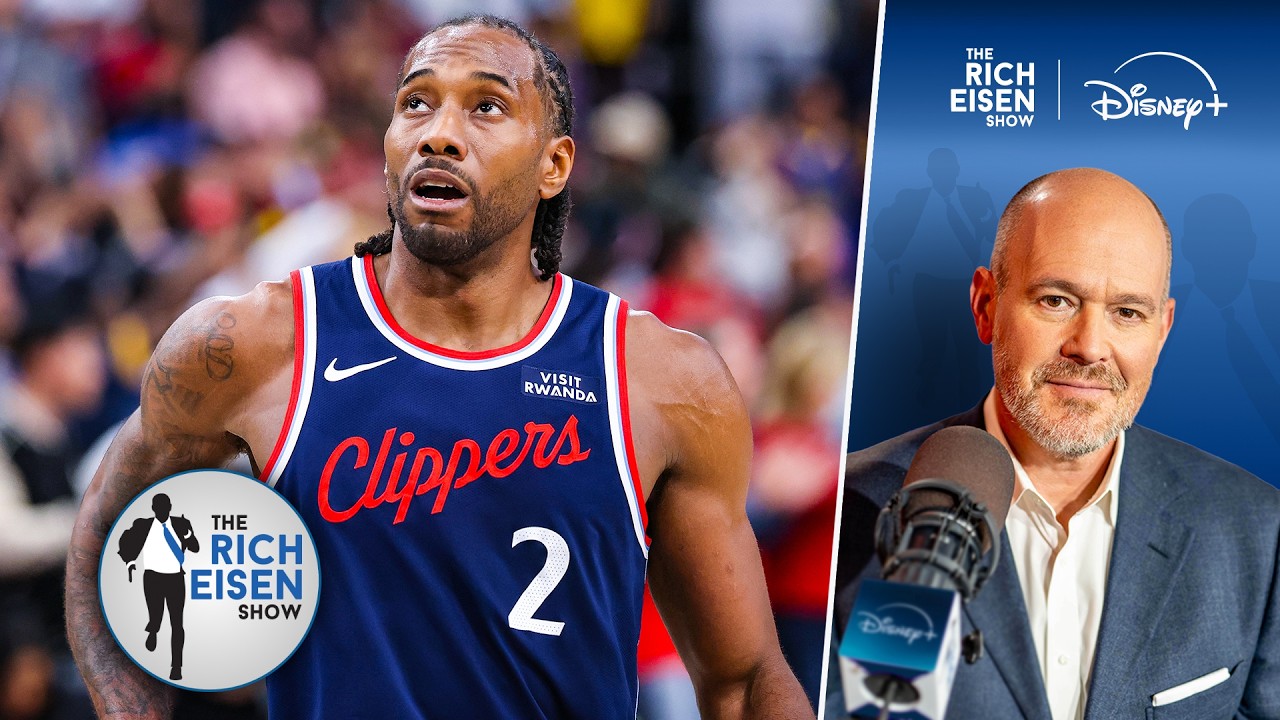
Rich: Kawhi Leonard May Be the Worst Acquisition Ever In the History of Professional Sports
Rich has a category for this now, and he built it live on the air. The Kawhi Leonard acquisition, he argued, belongs on the Mount Rushmore of the worst acquisitions in the history of professional sports.
He was careful about the jurisdiction. "On planet Earth. I can't make the galaxy claim, because I don't know what professional leagues there are outside of Space Jam."
The ledger he read out is what got him there. Front office executives suspended without pay. A 30 million dollar fine. Five first-round picks. Five years of probation. And Steve Ballmer barred from the building he built, unable to sit and look at the wall he put up in it.
Then the other side of the transaction. Leonard heads to Toronto essentially unscathed, out 700,000 dollars and carrying questions about his integrity that his statement says he cares about. Rich's read on the long run was unsentimental. Leonard knows where this ends for him regardless. He is getting his orange jacket.
That asymmetry set off the real argument in the studio, which was whether Ballmer got off easy. The case for yes is arithmetic. A 30 million dollar fine, to a man of that wealth, is roughly twenty bucks to everyone else, and he is lucky the league did not take the team.
Rich pushed back on the idea that forcing a sale was ever available here, and the distinction he drew is the important part of the segment. Yes, there is precedent for the NBA forcing an owner to sell. But he does not think the two situations belong in the same conversation. One is a rules violation, a matter of circumventing the salary cap, and the league's message to the other 29 teams is do not even think about trying this again, look what we just did to the Clippers. The other was categorically different, a matter of conduct rather than accounting.
"Those things aren't even in the same realm of the planet Earth at all."
Which brought him back to the thing that actually offends him, which is not the punishment. It is the trade.
Rich walked the full price. Leonard's condition for coming was that the Clippers also get him Paul George. They did it. Oklahoma City took all that capital and all those players and used it to build what it has now, in the same conference. And then, per the NBA's documents, the acquisition came with a whole set of side deals underneath it.
The comparisons offered from around the desk were the traditional ones. Herschel Walker. Deshaun Watson. Rich's view is that this clears them, and he explained the standard he is using.
"Name me another guy or woman who was acquired by a team that also leaves the team that gets them ringless. Ringless."
That is the test. Not merely a bad trade, but one that hands a rival an MVP and a champion and ten first-round picks while delivering nothing in return but sanctions. When someone floated European soccer as a place where something comparable might be hiding, Rich allowed for the possibility and doubted it. On par with ten first-round picks and an MVP and a title, for another franchise?
He also made the point that the money at the center of all this, next to everything it triggered, barely registers. "Chump change compared to everything else that's going on right now. Chump change. And look who's the chump."
The complication, and Rich landed on it honestly, is that the label does not stick to the person it was aimed at. "Kawhi won't care being called a chump. He won't care." The people left holding the bag are everyone else in the building.
Then he stopped himself, which is its own kind of verdict on a story this size. "Okay. I said my peace."
Watch the full interview on The Rich Eisen Show, streaming live on Disney+ weekdays Noon-3PM ET.
Adapted from the original segment on The Rich Eisen Show. How we cover the show.