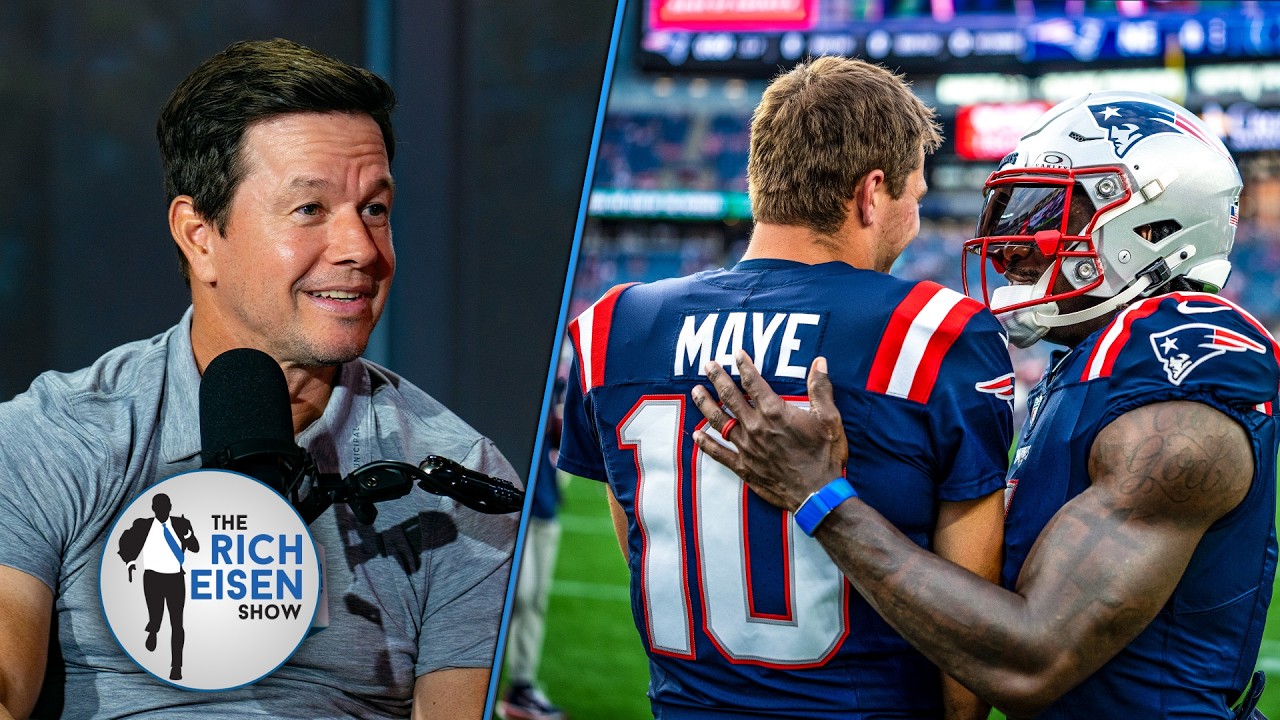
Patriots Games: Mark Wahlberg Plays the Rich Eisen Show's 'NFL Win-Loss Game' for His Beloved Pats
Mark Wahlberg has made a lot of movies and played a lot of memorable people. He put By Any Means at the top of the list anyway.
The character is Greg Scarpa, known as the Grim Reaper, a man Wahlberg described as having "probably more recorded murders in the history of the mob than any other mob figure." What pulled him in was not the body count. It was the partnership at the center of the true story, and a detail that genuinely surprised him. Scarpa helped crack the Mississippi Burning case and another case in 1966 involving a voting activist. "I was just blown away."
Wahlberg's read on him is that Scarpa was never a conventional informant. "This guy thought he was James Bond." When investigators could not get answers, Scarpa had "a very specific method of getting lots of information quickly," and he spent the film trying to convince his partner this was simply how things needed to be done. The strangest part of the record is that Scarpa never helped the government convict anyone in the mafia. He used the relationship in the other direction, to help his own people get away with things. To this day, Wahlberg noted, the FBI has never acknowledged his role.
He had circled this character before, once discussing playing Scarpa with Antoine Fuqua in a project set around the Colombo wars. This version arrived as one of the Blacklist scripts, meaning one of the best unproduced screenplays in Hollywood, and as a supporting role with real bite.
The transformation involved prosthetics and significant weight, but the hair was his own. "People think I was wearing a wig. I was like the Departed hair. It was just like, I have to have this crazy comb over, that's all my real hair."
What actually unlocked the part was a moment on set. Scarpa's son Greg Jr., who rose higher in the ranks than his father did and was newly home, worked on the film alongside Wahlberg the entire time. When Wahlberg finally came out in full costume and makeup, Greg Jr. was sitting with Linda. "And he was like, oh my god, that's daddy." Wahlberg said it humanized Scarpa instantly. "Here's a guy who just lived in this world, which a lot of us don't really understand, and what he had to do to survive."
Rich then ran him through Celebrity True or False, and Wahlberg confirmed nearly all of it.
Yes, he still has the Boogie Nights prosthetic, though not the first one. The original, in his telling, "just kind of came up and hit me in the head," which ruled it out on practical grounds. He kept the one he actually wore. He does not bring it out. "I moved it once, and it was like, you know, it's like a homey the clown thing." Those days, he decided, are past us.
Yes, Paul Thomas Anderson told the kid in the firecracker scene to light them whenever he felt like it, so nobody knew when they were coming. Wahlberg's correction was that this went on far longer than the scene suggests. "He was just randomly lighting them off for 4 days." Four days in those clothes, with Alfred Molina and Thomas Jane. Which explains the shot everyone remembers. "That scene where I kind of blacked out and I was just like, you know, that kind of crazy thousand-yard stare. It was just like, when do we get out of here?"
On the singing, he pushed back gently on the premise that he tanked it. "I was a quasi rapper. I wasn't really a singer." He was trying to belt it. The performances were supposed to be bad, and he allowed that "it wasn't that hard to be bad."
The best story of the segment was Burt Reynolds. Wahlberg set the stage carefully. Reynolds had been the biggest star in the world for over a decade and was now being asked to do this movie, and he was struggling with the material and the dialogue. On the first actual day of principal photography, shooting the dishwashing room scene, Anderson came over to Wahlberg with a warning. Reynolds was not getting the rhythm of the writing, so he wanted to do an Irish accent.
Wahlberg assumed it was a joke. Then Reynolds came out and did it. "And I'm like, what the. I started laughing." Reynolds, he said, looked like he wanted to kill him, and walked off the set. When Anderson asked what he was doing, Wahlberg's defense was that he did not think it was serious, and then he escalated. "I want to do Russian. I can do Russian. Can I play Dirk as a Russian?"
It is the only scene in the film they reshot.
The postscript is better. Reynolds did not like the finished movie, fired his agent and his manager, and said a lot of negative things about it. Then he got nominated, and the tune changed. Wahlberg ran into him on the red carpet at the New York Film Festival, where Reynolds grabbed him in a headlock, always sweet to him because he knew Wahlberg was old school about his work. "Kid, I don't understand. I don't know what they see in this movie, but let's just go with it."
Wahlberg's answer then is his answer now. "I love the movie."
The Departed took some convincing, though not in the way the legend has it. Scorsese and Wahlberg had been discussing a different part, the studio wanted someone else, and Leonardo DiCaprio and Scorsese pushed for Wahlberg until the economics settled it. Scorsese then asked Ari Emanuel whether Wahlberg would play Sergeant Dignam. Emanuel said yes on his behalf. Scorsese called to say how excited he was. Wahlberg's response: "I ain't doing that."
He was in Toronto shooting Four Brothers with Invincible lined up next, and he was not interested. Emanuel called back five minutes later, less than pleased, and told him to go talk to Scorsese. Wahlberg agreed for reasons that had nothing to do with the part. "I'd like to go spend a weekend in New York. I'll go see him for a free ride."
Reading the script again changed it. "I got to show these guys that this is my wheelhouse." He took the job on one condition, that he could do whatever he wanted with whoever, and Scorsese agreed. The character came out of his own life. "It was a combination of my dad and all the guys that I grew up with and knew, and I felt more comfortable and more familiar with that world than anybody else." The hair, incidentally, was a running problem, because he was growing it out for Invincible.
That led to a Jack Nicholson story, which Wahlberg delivered as a golf story. Playing with Nicholson and Joe Pesci, Wahlberg watched Nicholson tee off with people still on the fairway ahead. Pesci told him to just watch. The man ahead turned around and demanded to know who he thought he was. "He goes, Jack Nicholson. How are you?" Then waved, and hit again.
They caught up to the group two or three holes later. Wahlberg's verdict was that Nicholson had a point. "He's away, no matter what."
On Ted, the answer was immediate. Kids do ask him to sing the thunder song, and not just older ones. "All the time." His standard reply is to check for a chaperone. "Is your parents here? You got permission to do this?"
He also explained why he almost passed. The pitch, as delivered, is a hard sell. A kid wishes his teddy bear alive and they sit around smoking weed talking nonsense. "I'm like, eh, I don't know about that one." So he did research, watching the 100th episode of Family Guy with his kids, which turned into total chaos on screen and both of them laughing hysterically, and then his wife walked in. He was in trouble for a week. The material, once he read it, read like "one of the best scripts I've ever read, like a great buddy comedy." His own kids, seeing the billboards and the bus ads on the way to school, thought they had finally earned a Wahlberg movie they could watch. They got the fight scene with the sound off.
The Other Guys is true too, and it is the purest version of the story. Wahlberg agreed to the movie before Will Ferrell and Adam McKay told him what it was. He had done comedic pieces but never a full comedy, and what sold him was a meal. Ferrell, he said, simply loves making people laugh, which is not universal among comics, many of whom are more serious than they appear and turn the set into something joyless. Five minutes in, Wahlberg told them he was in. "And they're like, we haven't told you the story yet. And I was like, yeah, well, you don't have to, but I'm in." They called him random. He called it intuition.
Then he explained the bit that runs underneath his whole performance. Wahlberg could not accept that Ferrell's character would be married to Eva Mendes, so he built every improvised scene around undermining it, positioning himself as her protector and trying to nudge his partner into danger. "I want him out of the picture and I want to help this woman." Production eventually asked him to dial it back. He did not. The cinematographer, who by Wahlberg's account slept through most takes and woke up to relight, was laughing hardest, because he understood exactly what was happening.
Invincible drew the shortest answer and the most bruises. Did he take real hits from real former NFL players? "Oh, yeah. I was getting laid out." He had played sports, including ice hockey in equipment, but never football in pads. So he lined up against former NFL and arena league players in 130 degree heat at Penn, went through Oklahoma drills, and got ear holed running down the sideline on what he called one of the bigger hits he took.
He tried diplomacy. Every night there was a barbecue at his trailer with cold beer and fresh food. "It didn't matter." At the end of each day he rode home on a scooter he had fitted with eagle wings, ice packs on his knees and shoulders, hair blowing back like Vince Papale. Even his stunt double could not help much, because the pads made him look like a little kid and the pants did not fit, so they used him mainly in the sandlot games. Wahlberg was out there for the rest.
The reward was being named an honorary Philadelphian, which for a Boston guy carries a particular weight. "It was an honor."
Two biopics are live. Wahlberg has been asked about playing Bill Belichick and has not read the script yet, but his answer to being asked was not complicated. "They said would I be interested? I said, why wouldn't I be?" A friend who produced and financed By Any Means holds the rights, and Wahlberg has been told Belichick himself is interested and involved, "which makes it a lot easier." Asked who plays Belichick, he answered in one word. "Hopefully me."
Pete Rose has been in development far longer and is closer, with production hoped for early 2027. The version they are building starts with Rose chasing the record, then managing the Reds as a player manager, and then everything else. Wahlberg's take on the man is affectionate and unsentimental at once. He believes Rose learned his lesson, that there is a cautionary tale in it, and also "a kind of Raging Bull, Wolf of Wall Street kind of amazing, wildly entertaining fun ride." He thinks Rose gets into the Hall now. "I just adore him. I think he was one of the greatest I've ever seen ever." His only worry is craft. "I just hope I'm still believable in playing him at that age."
Both projects, he stressed, are the kind that take years. Same as Scarpa. Same as The Fighter. "The good ones take time."
Then, already walking out, Wahlberg turned around and asked to play the win loss game for the Patriots.
He set his own expectation first by asking Rich for a number. Rich said last year was remarkable and 13 regular season wins would be hard to repeat, landing on 11 to 13. Wahlberg had looked at the schedule and thought they would match last year's record outright, and he is high on the quarterback. "Drake Maye is definitely the truth." Rich relayed that Kurt Warner calls Maye the best deep thrower in the game and describes his deep balls as hand-offs, and Wahlberg's contribution was that he and Warner are both horse dads, with daughters in jumping and equestrian, and that Warner had been sending him nice messages about how his daughter did at nationals in Michigan.
Then he went undefeated for most of a season. Wins over Seattle in the opener, on a championship hangover theory, then the Steelers and Aaron Rodgers at home, then Jacksonville. He gave Buffalo the first loss, on a split, and volunteered that he liked their coach and the one before him and is not sure they made the right decision. The Raiders got dismissed outright. "Raiders are toast." So did Miami, and he offered the Jets and Dolphins one consolation. "The only games that the Jets and the Dolphins are going to get a sniff at is when they play each other."
He gave Detroit the game in Germany on jet lag, and did it as a fan, saying he has always been a big Lions fan from time spent in Detroit and loves the coach and the quarterback. He gave Kansas City theirs, but not before objecting to the transaction that made it possible. "I don't know why the Seahawks traded their running back. This guy's Super Bowl MVP. The only guy we couldn't stop." Told they simply did not want to pay him, Wahlberg's verdict was one word. "That's terrible."
Then he won out. Final answer, 14 and 3.
Rich admitted he had been braced for 19. Wahlberg had considered it. "I thought about it, but I figured we'll be a little humble." His actual reasoning was about belief in the building. "I think Mike's got those guys really believing in themselves."
Asked who wins the AFC, Rich floated the Bengals, then Buffalo, then heard himself say the Chiefs are back. Wahlberg had a simpler answer. "New England could easily do it. It's a wide open conference." What he really wants is smaller and more specific. "It'd be nice to beat Buffalo one more time, win the division."
He does respect the problem. "Love Josh Allen. The guy's a beast." His comparison was Ben Roethlisberger, and Rich finished the thought. Once he is hit, the play begins.
Watch the full interview with Mark Wahlberg on The Rich Eisen Show, streaming live on Disney+ weekdays Noon-3PM ET.
Adapted from the original segment on The Rich Eisen Show. How we cover the show.


